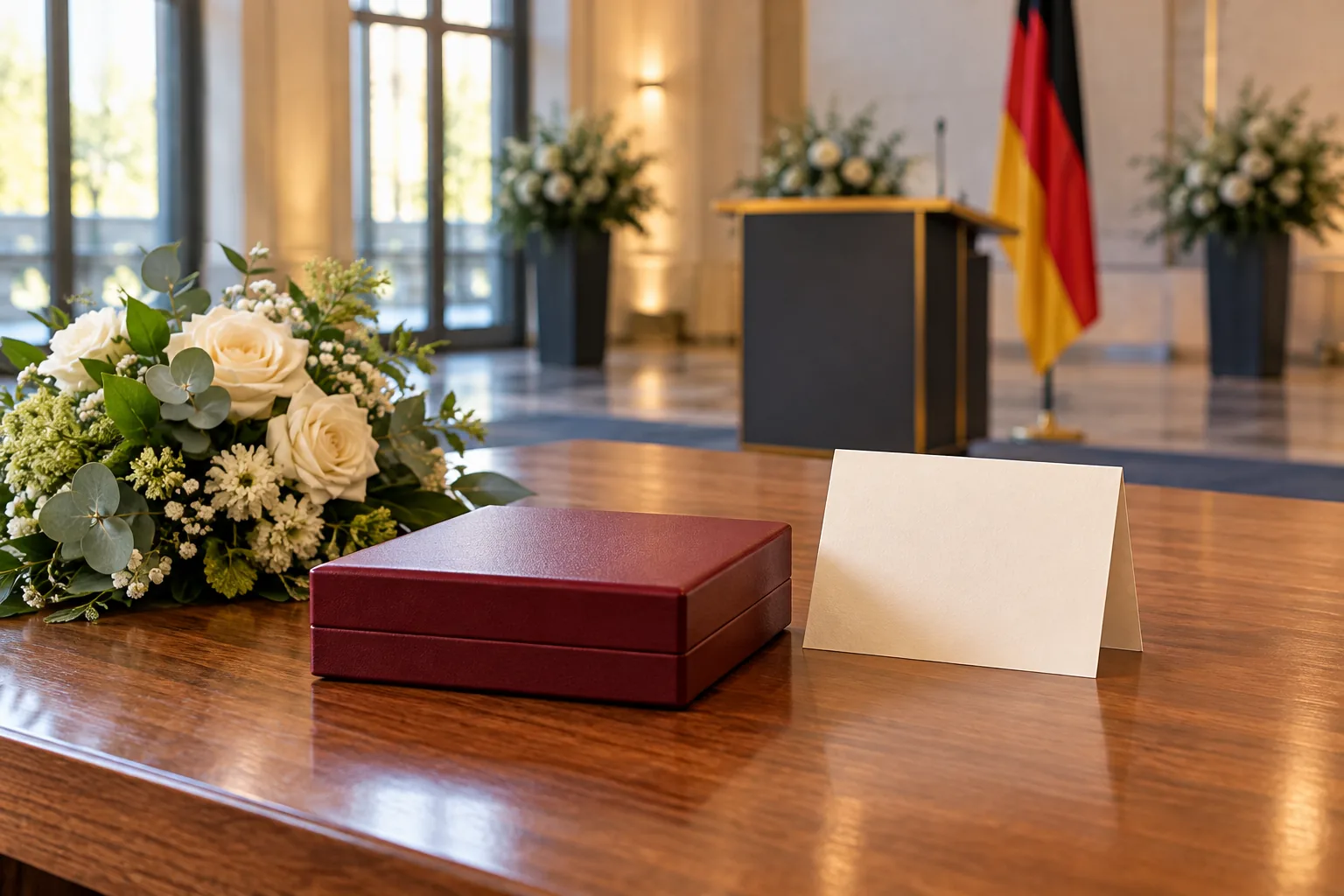
An honour makes public recognition visible.
Many people contribute beyond their everyday duties through social commitment, culture, scholarship or other areas of public life. A state honour may recognise that exceptional contribution. The question lists several such fields and asks for the name of the relevant award.
The formal umbrella name is the Order of Merit of the Federal Republic of Germany. It has several classes; everyday speech often uses “Federal Cross of Merit” for the award generally. An order is not a political office or permission to exercise authority over other people.

The other three answers
Distinguish today’s personal honour from an emblem and historical GDR awards.
Federal Eagle
The federal eagle is a national emblem. It is not the personal award for service sought here.
Patriotic Order of Merit
The Patriotic Order of Merit belonged to the former GDR’s awards. This question concerns the Federal Republic of Germany.
Honorary title 'Hero of the German Democratic Republic'
The title itself names the German Democratic Republic. It is not the Federal Republic’s Order of Merit.
An outstanding contribution does not create an automatic entitlement.
Awards follow a regulated nomination and assessment process. Not every good deed or ordinary performance of a job leads to an honour; the official rules describe exceptional service and conditions.
The award is not restricted to one occupation. People without German citizenship may also receive it. The illustrations show only symbolic or fictional scenes, not an actual award ceremony.
Order of Merit · Office of the Federal President ↗Exceptional service → Federal Cross of Merit.
The word “merit” connects the reason for the honour with its name.
Three words for this question
- der Verdienstmerit / service
- Here: an exceptional contribution to others or the public good.
- die Auszeichnungaward / honour
- Visible public recognition of a contribution.
- verleihento confer / award
- To grant an honour officially.