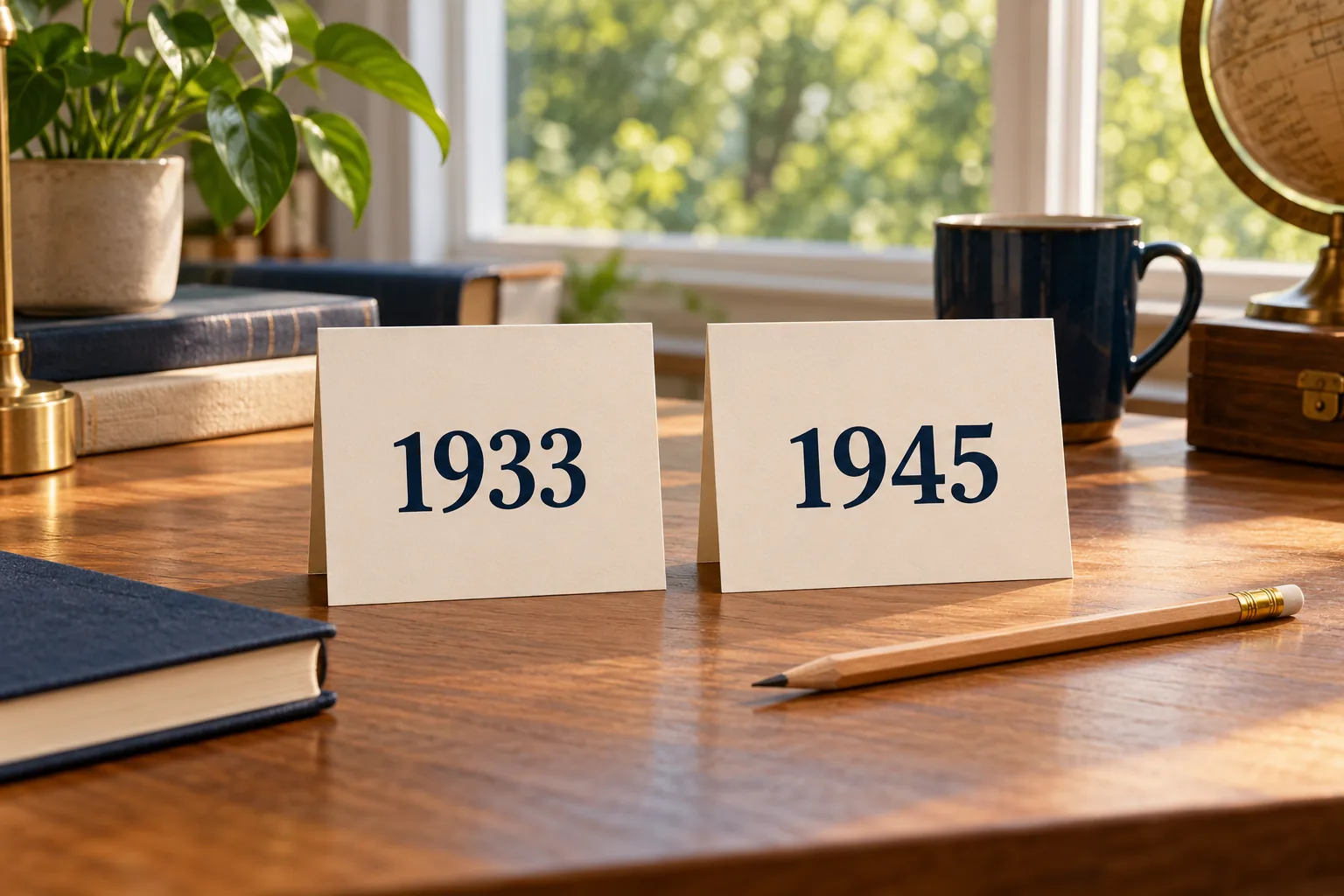
A familiar pair of years must fit the right question.
This task resembles question 152 but uses different incorrect options. It still asks about Nazi rule in Germany. The correct time span therefore remains 1933 to 1945.
It helps to distinguish a party from a state. Hitler led the Nazi Party before 1933. This does not mean the party already controlled the state then. Appointment as Chancellor in January 1933 is the decisive turning point for this question.

The other three answers
Short contrasting labels help resolve these confusions.
1888 to 1918
1888 to 1918 is the reign of Emperor Wilhelm II. Nazi rule began later, in 1933.
1921 to 1934
Hitler took leadership of the Nazi Party in 1921. Party leadership is not state government, and Nazi rule ended in 1945, not 1934.
1949 to 1963
1949 to 1963 is Adenauer’s term as Federal Chancellor. It falls after the end of Nazi dictatorship.
Similar-looking dates do not mean similar systems.
A timeline orders events without equating them. Imperial monarchy, Nazi dictatorship and the parliamentary Federal Republic differ fundamentally. The correct answer is therefore more than an arbitrary pair of numbers.
The Nazi regime was not a dictatorship only during the war. Repression and persecution began before 1939. The 1933–1945 period includes those pre-war years.
Nazi regime · German Historical Museum ↗1921: party leadership. 1933: state power. 1945: the end.
The first year explains why an incorrect option may sound familiar. For the question about Nazi rule, however, 1933 and 1945 are the relevant dates.
Three words for this question
- die Parteiführungparty leadership
- Leadership of a political party, not automatically government of a state.
- die Regierungszeitperiod of rule
- The period during which a person or political leadership governs.
- die Epochehistorical era
- A period of history with particular defining characteristics.