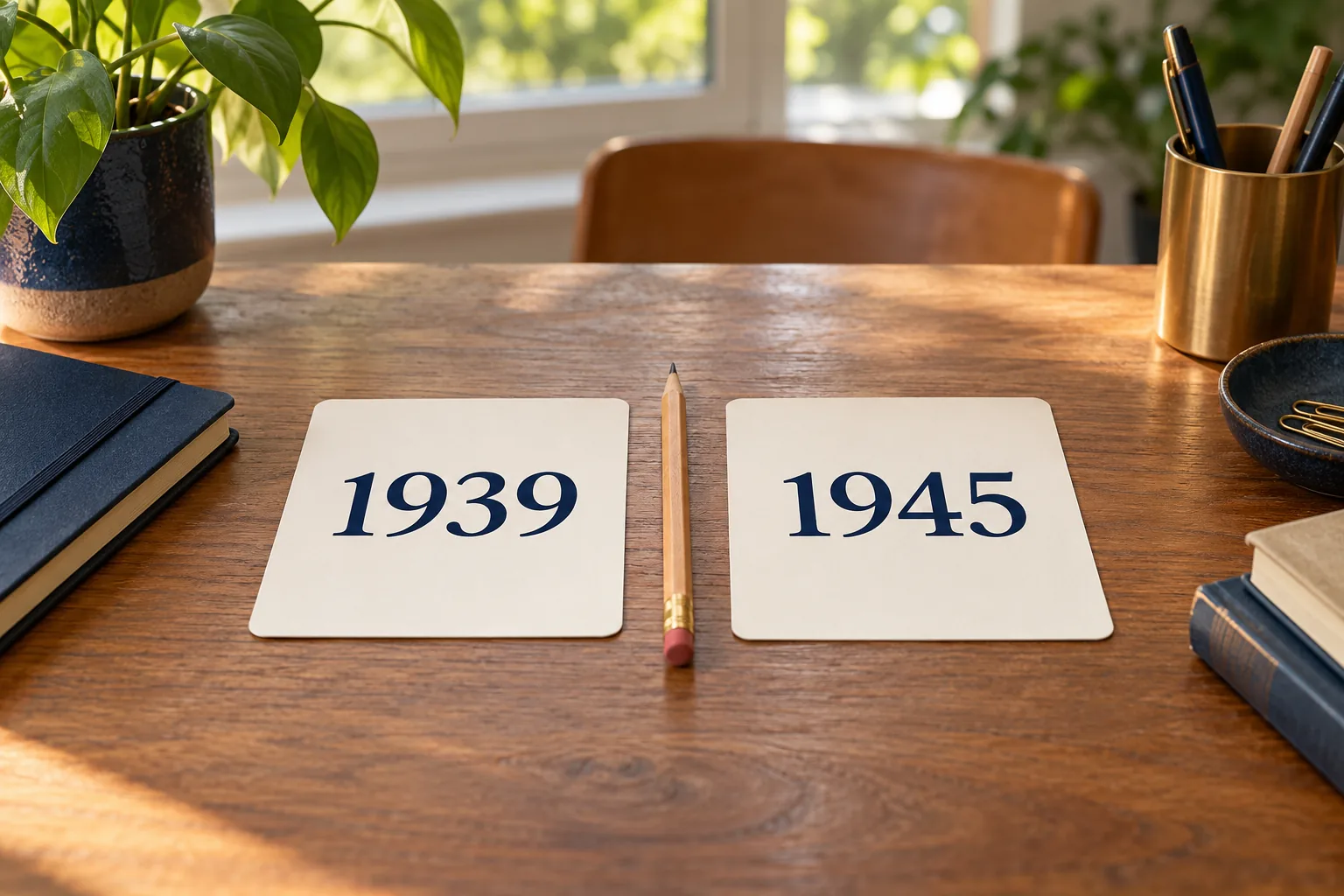
Two endpoints identify the historical conflict.
This question gives you the years and asks for the war’s name. It reverses the learning direction of a question about the final year. Connect 1939 with the invasion of Poland and 1945 with the defeat of the Axis powers and the end of the war.
Nazi rule began in 1933. Distinguishing the periods makes the similar sequences easier to place: Nazi rule in 1933–1945, World War II in 1939–1945. A shared end does not mean a shared beginning.

The other three answers
The other wars belong to clearly different periods.
World War I
World War I lasted from 1914 to 1918. It ended long before the 1939 starting point given here.
the Vietnam War
The Vietnam War belongs to a later part of the twentieth century and ended in 1975. Its final year therefore does not match 1945.
the Gulf War
Gulf War refers to later conflicts, such as the war over Kuwait in 1990–91. The Iran–Iraq War of 1980–1988 also does not fit 1939–1945.
The period does not replace regional chronology.
1 September 1939 marks the beginning of World War II in Europe with Germany’s invasion of Poland. The war developed into a worldwide conflict; participating countries did not all enter on the same day. The test uses the conventional period of 1939–1945.
The ending also needs more precise distinctions: the war ended in Europe in May 1945; Japan’s surrender instrument was signed in September. Both events confirm the final year of the correct answer.
World War II · German Historical Museum ↗First: 1914–1918. Second: 1939–1945.
Learn the two world wars as separate pairs. Nazi rule from 1933 is another time span and must not replace the 1939 starting point.
Three words for this question
- der Weltkriegworld war
- A war involving many states and several world regions.
- der Überfallinvasion / attack
- Here, Germany’s military attack on Poland.
- der Zeitraumperiod
- The interval between two points in time.