
Identify the custom, not just any festival.
At carnival, people can take on imaginary roles and celebrate together. A mask or colourful costume is therefore the question’s key clue. Carnival Monday belongs to this festive context.
Depending on the region, you may encounter the terms Karneval, Fastnacht and Fasching. They refer to related festive traditions whose characters, masks and proceedings can differ. The exam question does not require memorising a regional costume code.
The other three answers
Not every distinctive festive outfit is a carnival costume.
on May Day
May Day is not the carnival day sought in this question. The clue “costumes and masks” points to Carnival Monday.
at Oktoberfest
Traditional dress such as a dirndl or lederhosen is common but voluntary at Oktoberfest. It is not the carnival custom sought here.
at Pentecost
Pentecost is a Christian celebration of the Holy Spirit. Here, the question about colourful disguises points to carnival and Carnival Monday.
A widespread custom is not compulsory for everyone.
The question describes a cultural association, not a rule of conduct. No one has to dress up, wear a mask or enjoy carnival. Someone without a costume can still understand the term correctly.
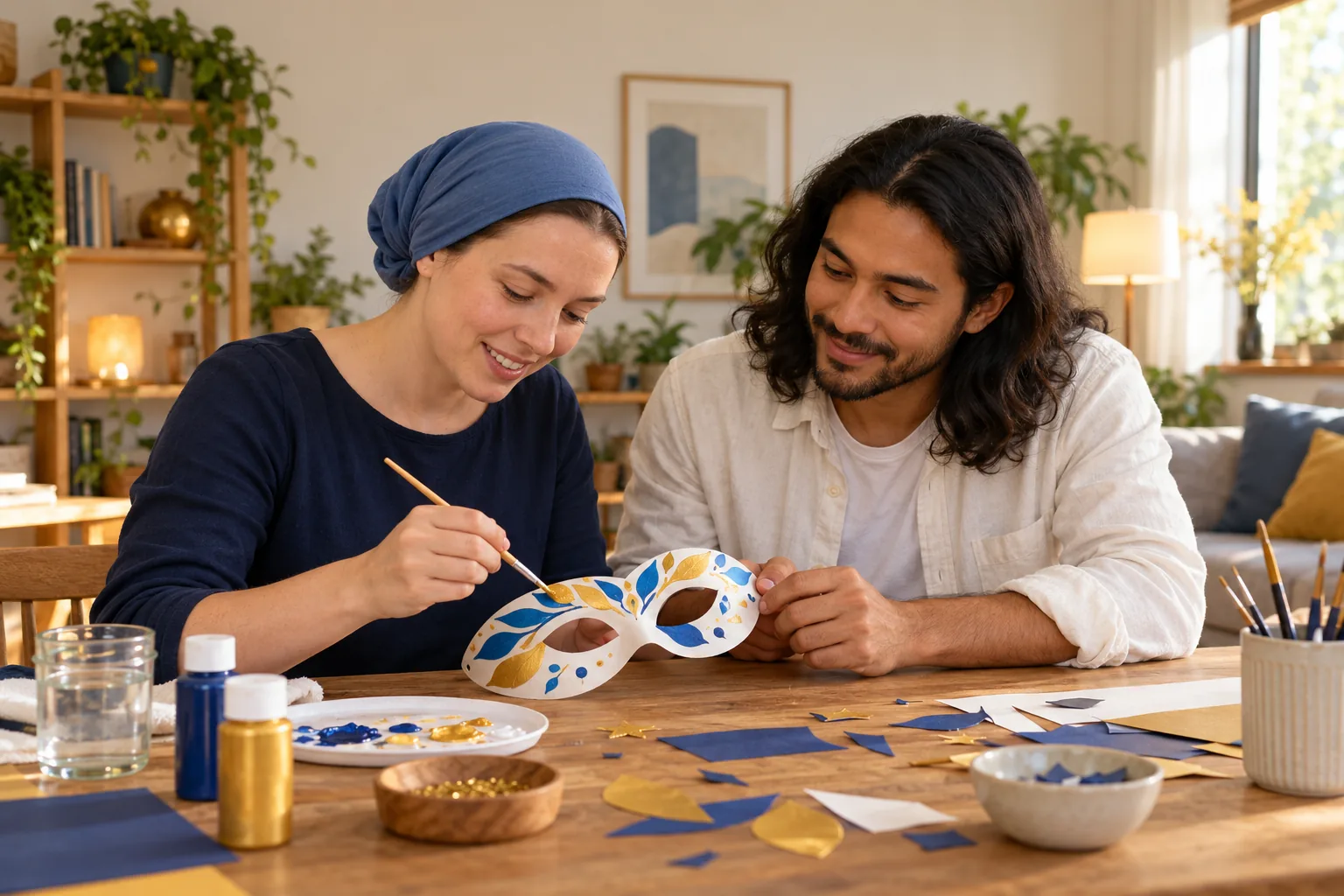
Masks and costumes are not used exclusively on Carnival Monday. The task asks for the best answer among these four choices. The editorial images show an invented craft scene, not a documented parade.
Rhenish carnival · German Commission for UNESCO ↗Carnival Monday → carnival → costumes and masks.
Link the name to the custom. You do not need to turn it into a claim about every region or every person.
Three words for this question
- sich verkleidento dress up in costume
- To represent another or imaginary role through clothing.
- der Brauchcustom
- A practice passed on or maintained within a community.
- die Fastnachtcarnival
- A regional term for related festive traditions before Lent.